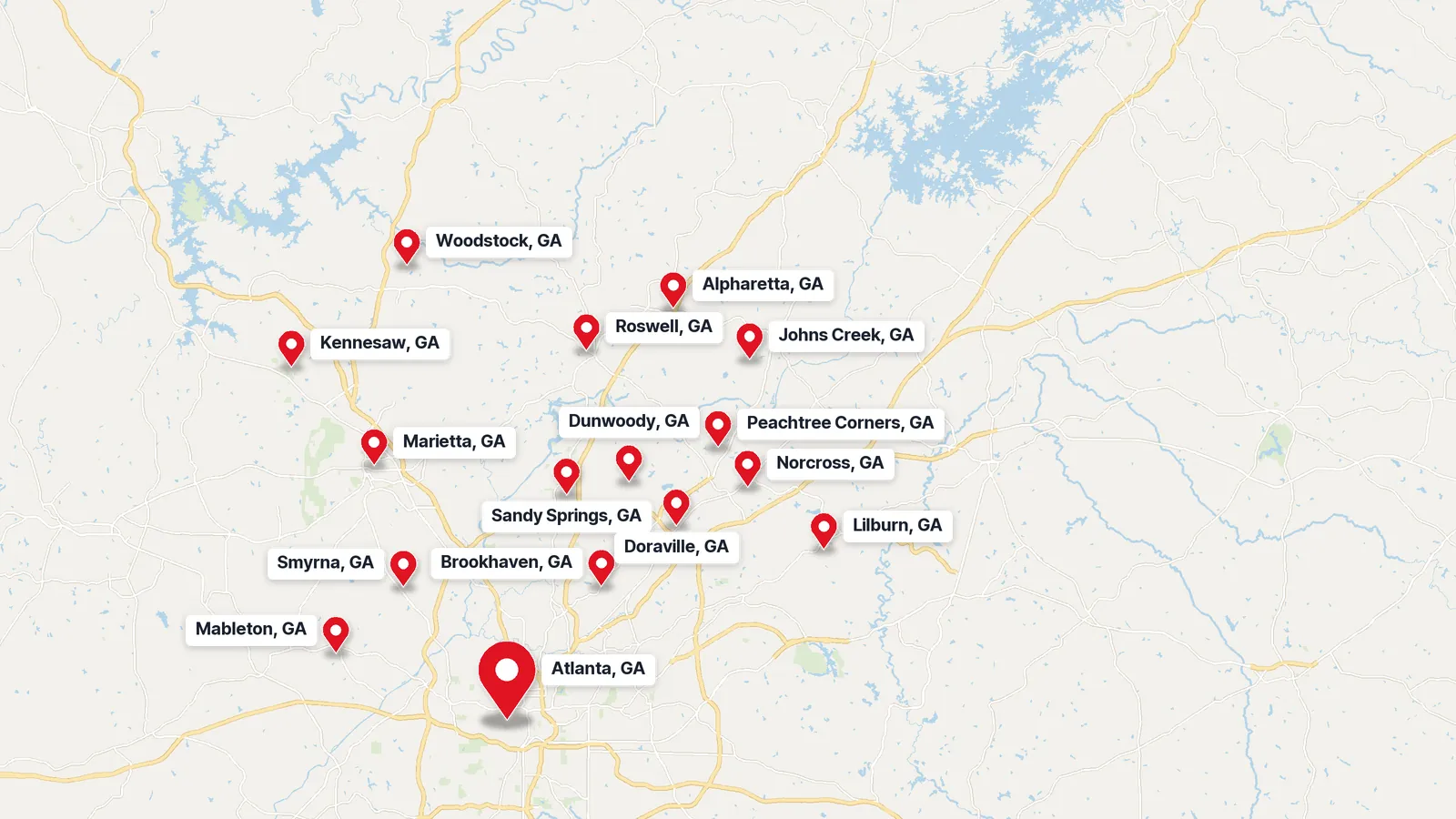
Serving Atlanta, GA from Woodstock
Mold and Water Damage Help for Atlanta Homes
Tell us what you're seeing in your Atlanta home and we'll help you work out the next step.
How We Help Atlanta Property Owners
If you're dealing with mold, a leak or a soggy floor in Atlanta, we can help you sort out what's wrong and get it fixed. Woodstock Mold Remediation handles mold remediation, water damage restoration, odor removal and air purification, dehumidification and structural drying, carpet and flooring replacement, and painting and refinishing. That means one team can take you from the wet or moldy problem through the rebuild, so you aren't juggling several companies while your home is torn up.
We work out of Woodstock and make the drive into Atlanta, so we plan visits around the interstates and your schedule. Atlanta's mix of old bungalows, brick ranches, townhomes and high-rise apartments means no two jobs look alike, and we start by finding where the moisture is coming from. If you tell us where you are and what you're seeing, we'll talk through the next step with you. Contact Woodstock Mold Remediation with your location and we'll go from there.
What Your Atlanta Home Might Need
Because Atlanta is humid and storms are common, we see how mold and water damage tend to show up together, so we treat them as one problem. We handle mold remediation, water damage restoration, and dehumidification and structural drying for wet basements, crawlspaces and attics, then odor removal and air purification once the source is dealt with. When materials have to come out, we do carpet and flooring replacement and painting and refinishing, so the finished rooms look right again. Older intown houses and newer slab homes each call for a different approach.
Getting to Know Atlanta
Atlanta started in 1837 as Terminus, the planned southern end of the Western & Atlantic Railroad. It was renamed Marthasville in 1843 and Atlanta in 1845, and it became a city on December 29, 1847. The railroad made it a hub, and then in 1864 much of it burned during the Civil War. You can read the full story in Atlanta's Wikipedia article, including how the city rebuilt and became Georgia's capital in 1868.
Today Atlanta is known for Hartsfield-Jackson Atlanta International Airport, Delta Air Lines, The Coca-Cola Company, CNN and the Centers for Disease Control and Prevention. It's also known for the civil rights legacy of Martin Luther King Jr., and the Martin Luther King Jr. National Historical Park keeps that story close to home. The city hosted the 1996 Summer Olympics, and Centennial Olympic Park downtown is a reminder of it. About 520,000 people live here now, and the number keeps climbing.
Business life here spreads across several districts, including Downtown, Midtown, Buckhead, West Midtown and the BeltLine corridor, and Downtown Atlanta Inc. is a good place to see what's going on in the core. Ponce City Market, Georgia State University, Georgia Tech and Emory University all add to the mix. For us, that means everything from single-family houses to lofts and apartment buildings, and each one handles moisture a little differently.
Atlanta is often called a city in a forest, and the heavy tree canopy is easy to spot from almost any street. It sits in the Piedmont region of north Georgia, with Peachtree Creek and other streams running through it, and you'll find green space like Piedmont Park, Chastain Park and the Atlanta Botanical Garden. All that greenery comes with a humid subtropical climate, so summers are hot and sticky and rain falls through the year. That's good for the trees and tough on damp basements.
How Atlanta's Homes Shape the Work
Atlanta's housing is a real mix, and the age of the building tells us where to look first. Intown neighborhoods have early-20th-century bungalows, Craftsman homes and Victorian houses, and many sit over crawlspaces or basements. Mid-century ranches and brick colonials are common on the north side, including Sandy Springs. Older homes often have limited ventilation, so moisture can hide in subfloors, attics and behind plaster or drywall long before you smell anything.
Newer infill houses, townhomes and apartments appear all over the city, especially in Midtown, Buckhead and along the BeltLine. Many of these are built on slabs, so leaks tend to come from plumbing, windows, roofs or HVAC lines instead of crawlspaces. Intown Atlanta also has a lot of renters, and in a building with shared walls and floors, water from one unit can reach another. We look at how your building is put together before we plan the drying.
Woodstock Mold Remediation in Atlanta, GA
We look for the moisture source
Mold returns when the water that fed it is still there, so we trace leaks, drainage and humidity first, whether it's an old crawlspace or a newer slab home.
One team from cleanup to repainting
The same crew that dries and treats the space can replace your flooring and repaint, so you deal with one contact on the drive from Woodstock and back.
What to Know Before Work Starts in Atlanta
Check which city office covers your address
Atlanta permits and inspections go through the Office of Buildings in the Department of City Planning. Sandy Springs is a separate city with its own permitting, so the boundary matters. Mold removal alone may not need a permit, but rebuild work with structural, electrical, plumbing or mechanical changes usually does.
Red clay and sloped lots
The Piedmont has clay soil that's often red, and many lots slope. Water can collect against foundations, which is why basements and crawlspaces here are prone to dampness. Fixing drainage outside is often part of keeping mold from coming back inside.
Summer humidity and storm seasons
Hot, humid summers keep moisture lingering, and thunderstorms, straight-line winds and tropical remnants can cause roof damage and leaks. Tree falls are common in a city this wooded. Mold can start within a few days of a wet event, so don't wait.
Creek and urban flooding
Atlanta has had urban and creek flooding, including the September 2009 floods, and Peachtree Creek is one of the streams affected. If you're in a low spot near a creek, tell us about any past water so we can look for hidden moisture in walls and flooring.
Historic districts and HOAs
Older neighborhoods may have design review rules, and HOAs are common in newer subdivisions. Interior mold work is usually less affected, but exterior paint or roof changes can need approval. Check with your neighborhood or HOA before planning visible repairs.
Free Estimates in Atlanta, GA
Send us your Atlanta address and a few details about what you're seeing, and we'll help you decide what to do next.
Questions From Atlanta, GA
Does Georgia require a license to remove mold in Atlanta?
Georgia doesn't have a state license specific to mold remediation. Rebuild work over the contractor licensing threshold, like drywall, framing and flooring, falls under the State Licensing Board for Residential and General Contractors. You can read the Board's FAQ and ask any company for its license details before work begins.
Do I need a permit in Atlanta for mold removal and repairs?
Mold removal alone may not need one, but rebuilding with structural, plumbing, mechanical or electrical changes usually does. Atlanta's Office of Buildings, at 55 Trinity Avenue SW, handles permits and inspections. Georgia codes based on the 2024 International Residential and Building Codes apply to permit submissions starting January 1, 2026. If you're in Sandy Springs, that city has its own office.
My Atlanta landlord won't fix a leak that's causing mold. What can I do?
Georgia law makes landlords responsible for keeping rental premises in repair, and the Safe at Home Act added a habitability duty for leases signed or renewed on or after July 1, 2024. The law doesn't name mold. Put the problem in writing, keep photos, and get legal advice before withholding rent or fixing it yourself.
Will my homeowners insurance cover mold after a storm?
It depends on your policy. Mold that follows a covered, sudden water loss is often treated differently from long-term seepage, but the wording of your policy decides. Read it closely and ask your insurer what applies. If a claim is mishandled, you can file a complaint with the Georgia Department of Insurance.