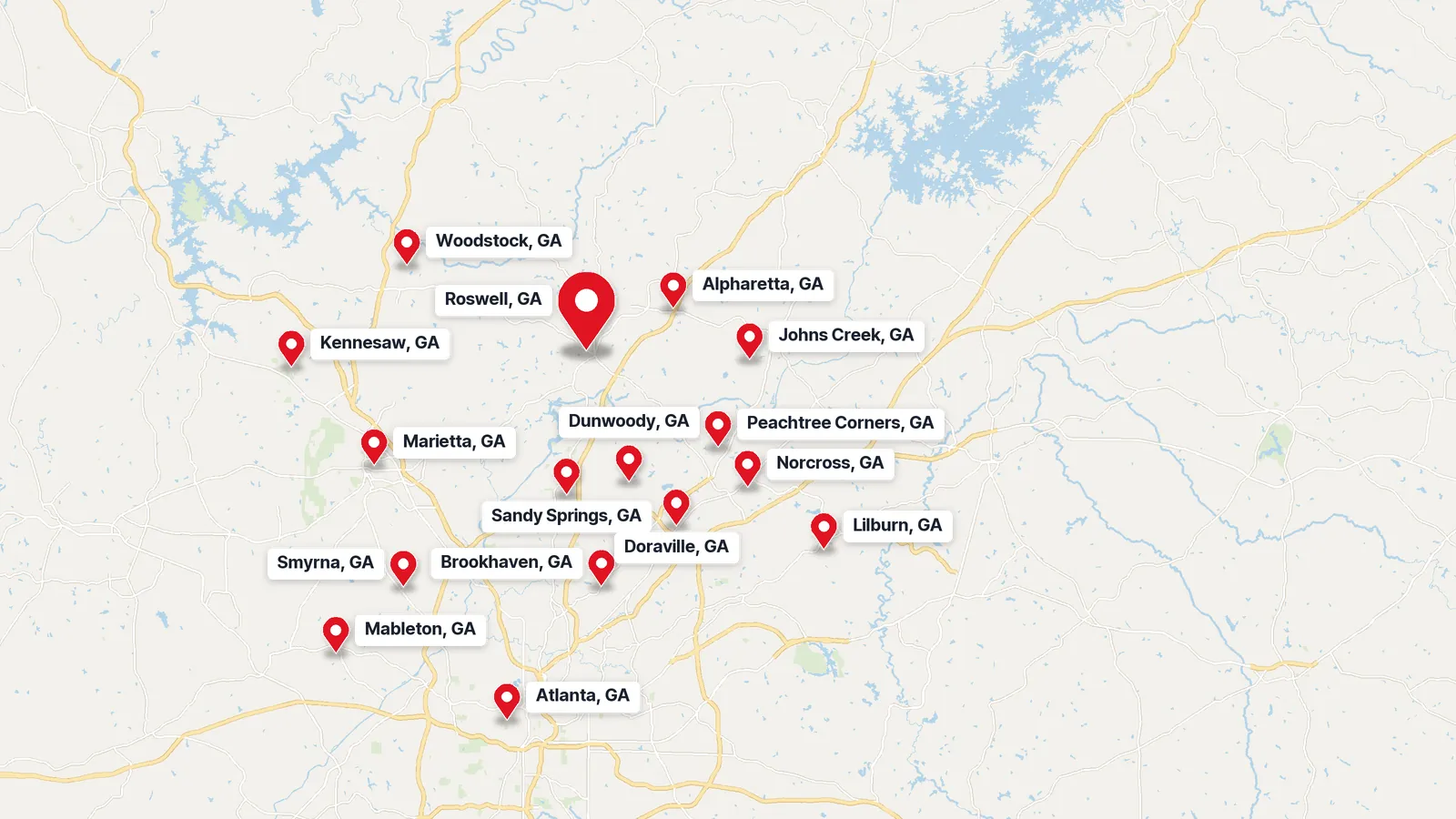
Serving Roswell, GA
Mold and Water Damage Help for Roswell Homes
Tell us what you're seeing in your Roswell home and we'll help you sort out the next step.
What We Do for Roswell Homes
If you've found a musty smell, a stain spreading on a ceiling or a wet spot under the carpet, we can help. Woodstock Mold Remediation handles mold remediation, water damage restoration, odor removal and air purification, and dehumidification and structural drying for homes across Roswell. We also do carpet and flooring replacement and painting and refinishing, so the same team can take you from cleanup to a finished room.
Roswell's humid summers and heavy spring storms give moisture plenty of chances to get into a house, and the older the home, the more places it can hide. You don't have to figure out the source on your own. Send us a note with your address in Roswell and a few details about what you've noticed, and get your free estimate.
Getting to Roswell From Woodstock
We head to Roswell from our base in Woodstock, which is about 10 miles away in a straight line. The usual drive is roughly 25 to 35 minutes, depending on traffic, and it generally means working east and south on the main roads toward the north Fulton area, then picking up GA-400, which runs just east of the city.
Once we're close, Holcomb Bridge Road, Alpharetta Highway and Roswell Road carry us to most parts of town. Those roads connect the retail corridors, the subdivisions in Mountain Park and Sandy Plains and the historic core near Canton Street, so we can reach different sides of Roswell without much trouble.
About Roswell
Roswell began in 1839, when Roswell King and his son Barrington King built a cotton mill beside Vickery Creek and the Roswell Manufacturing Company was chartered that December. Barrington's Greek Revival house, Barrington Hall, was started that same year and finished in 1842, and today it's a house museum run by the City of Roswell. The town was incorporated in 1854, and you can read more of its story on Wikipedia.
Today Roswell is a city of about 93,000 people in north Fulton County, and it was counted as Georgia's ninth-largest city in 2020. You'll find a National Register historic district, antebellum homes like Bulloch Hall, the dining strip along Canton Street and Roswell Town Square, plus the Chattahoochee River along its southern edge. Away from the old core, most of the city is quiet, subdivision-style neighborhoods.
How We Help Roswell Properties
Most of our work here starts with mold remediation and water damage restoration, because Roswell gets about 50 inches of rain a year and much of it comes in spring and summer storms. We pair that with dehumidification and structural drying, so the framing and subfloor actually dry out and the mold doesn't return. Odor removal and air purification handle the musty smell left behind, and carpet and flooring replacement and painting and refinishing put your rooms back together, whether yours is a 1980s two-story or an older home near the historic district.
Roswell Areas We Serve
We work across Roswell, from the old mill town to the subdivisions that fill most of the city.
Roswell Historic District
The original mill town around Canton Street and Town Square, with antebellum homes like Barrington Hall and Bulloch Hall and the city's oldest houses.
Mountain Park
Older suburban subdivisions in ZIP 30075, mostly built from the 1970s to the 1990s, where aging systems and original materials are common.
Sandy Plains
Suburban neighborhoods in the north and west of the city, a mix of single-family subdivisions and newer developments.
Riverwalk
A neighborhood directly across from the Chattahoochee River, where river humidity and storm runoff are worth keeping in mind.
ZIP 30076 area
The eastern side of Roswell next to Alpharetta and Johns Creek, home to roughly 44% of the city's residents.
What to Know About Work in Roswell
Many homes are from the 1980s
The typical Roswell home was built around 1989, so plumbing, roofing, siding and HVAC components are now decades old. Slow leaks and aging seals are common starting points for hidden moisture, and we look at those spots first.
Heavy spring and summer rain
Much of Roswell's rain falls in storms between March and July. Overflowing gutters, poor drainage and wind-driven water around roofs and siding can soak walls and crawlspaces, so we check how water is reaching your home.
Rebuild work can need permits
Electrical, plumbing, mechanical and structural repairs can need permits from the Building Permits & Inspections office at the City of Roswell. Roswell has its own office, so rules from other cities don't apply here.
Historic district homes
The oldest homes sit around Canton Street and Mill Village. Older materials and construction can need gentler handling, and exterior work may involve city review, so it's worth asking the city before you plan changes to the outside.
HOAs and county lines
Roswell is in Fulton County, and many neighborhoods have HOA covenants. Interior mold work is usually less affected, but exterior paint or roof repairs may need approval, so read your covenants before you start rebuilding.
What to Do Until Help Arrives
Stop the water first
If you can see where water is coming from, like a supply line, an overflowing gutter or a drain, shut it off or divert it safely. Mold can start within a few days of getting wet, so cutting off the source matters most.
Dry what you safely can
Open windows when the air outside is dry, run fans and pull wet rugs and belongings off damp floors. Roswell summers are humid, so don't count on the air to do the work for you.
Leave the mold alone
Don't scrub, sand or spray moldy areas, and don't paint over stains. That can spread spores and hide the problem. Take photos, keep the area closed off and note when you first noticed it.
Woodstock Mold Remediation in Roswell, GA
We treat the moisture, not just the mold
Mold returns when the water source stays. We look for where moisture is coming from and dry the structure, which suits Roswell's wet springs.
One team from cleanup to finish
Because we also handle flooring and painting, you deal with one team from removal through the finished room, whether you're in a subdivision or the historic district.
Free Estimates in Roswell, GA
Send us your Roswell address and a few details about the damage, and we'll tell you what we'd look at first.
Questions From Roswell, GA
Does Georgia require a license for mold removal in Roswell?
Georgia has no state license specific to mold remediation. Rebuild work above a dollar threshold, like drywall, framing or flooring, falls under contractor licensing through the Georgia State Licensing Board for Residential and General Contractors. You can always ask any company about its credentials and how it separates mold work from rebuilding in a written scope.
Do I need a permit from Roswell for repairs after water damage?
It depends on the work. Electrical, plumbing, mechanical and structural repairs generally need permits, and Roswell issues them through the Community Development Department's Building Permits & Inspections office at the City of Roswell. Whether mold removal alone needs one isn't clear, so check with the office before you start rebuilding.
Will my insurance cover mold in my Roswell home?
It depends on your policy. Mold from a covered sudden water loss is often treated differently from long-term seepage, so read your policy wording closely. If you think a claim was mishandled, you can file a complaint with the Georgia Department of Insurance. Take photos and keep records of when you first saw the damage.